
For most of the last decade, homeowners insurance was an afterthought in a home purchase — a line item you handled somewhere between the inspection and the final walkthrough. That is no longer true in Southern California. Today, an insurance quote can change how much home you qualify for, and a late insurance application can delay or kill an otherwise clean escrow.
Bill Lewis at Choice One Mortgage has spent more than 30 years financing homes across Southern California, from the Coachella Valley to Ventura County and the South Bay. This guide explains what your lender actually requires for insurance, how a premium quote affects your buying power, how the California FAIR Plan works alongside a mortgage, and when in the process you need to start shopping.
Why Insurance Became a Mortgage Problem
California's homeowners insurance market has been under severe strain since 2022. Major carriers paused or restricted new business, premiums climbed sharply, and homeowners in wildfire-exposed areas received non-renewal notices with few places to turn. The January 2025 Palisades and Eaton fires accelerated all of it.
For buyers, the practical consequence is simple: your lender cannot fund your loan without proof of bound hazard insurance. When coverage is scarce or expensive, insurance stops being paperwork and becomes a condition of approval — one that can move your numbers or your timeline.
There is real good news in 2026, and we will get to it below. But the buyers who close smoothly are the ones who treat insurance as part of the loan, not as an errand to run at the end.
How an Insurance Quote Changes What You Can Buy
This is the part most buyers do not see coming, and it is the single most important idea in this guide.
Your qualifying payment is not just principal and interest. Lenders qualify you on the full housing payment — principal, interest, property taxes and insurance, commonly called PITI, plus HOA dues where they apply. The insurance premium sits inside that calculation. When the premium goes up, the rest of the payment has to come down for your debt-to-income ratio to stay where it needs to be. That means a smaller loan.
Here is what that looks like in practice. Consider a buyer shopping in a fire-exposed part of Ventura County:
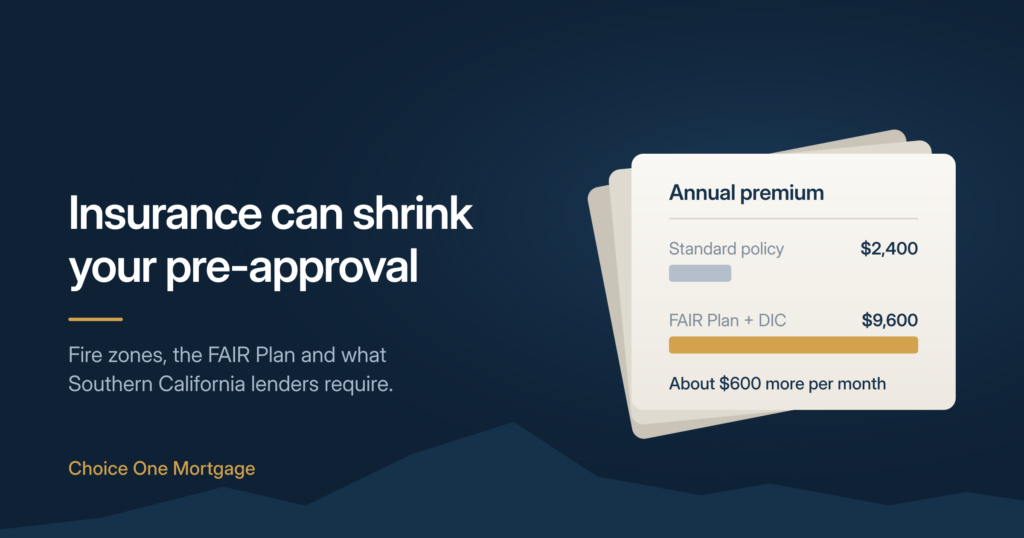
- Standard policy: $2,400 per year, or roughly $200 per month
- FAIR Plan plus a DIC wrap: $9,600 per year, or roughly $800 per month
The difference is about $600 a month of housing payment. At roughly 6.5% on a 30-year fixed, $600 per month of payment capacity supports somewhere in the neighborhood of $95,000 of loan amount. Same buyer, same income, same credit score, same down payment — and a purchase power swing of about $95,000 depending entirely on which property they pick and what it costs to insure.
These figures are illustrative, not a quote. Your actual numbers depend on the property, your rate, and your full financial picture. But the mechanism is real, and it is why we now ask buyers to get a preliminary insurance quote on a specific address before they write an offer, not after.
Not sure how insurance costs will affect your approval amount? Call Bill Lewis at Choice One Mortgage and we will run your numbers with a real premium in them.
Get a Free Loan AnalysisWhat Your Lender Actually Requires
Insurance requirements are not arbitrary, and they are not set by your loan officer. On conventional loans they come from Fannie Mae and Freddie Mac, and they trip up buyers in three specific ways.
Coverage Is Based on Rebuild Cost, Not Purchase Price
Fannie Mae and Freddie Mac require dwelling coverage of at least 100% of the insurable replacement cost of the improvements — or the unpaid principal balance of the loan, as long as that amount equals at least 80% of replacement cost. Coverage must be written on a replacement-cost basis, not actual cash value.
This surprises people constantly. Replacement cost is what it would take to rebuild the structure at today's construction prices. It has nothing to do with what you paid or what the land is worth. In parts of Southern California where land carries most of the value, replacement cost can be far below the purchase price. In others, construction costs push it higher than buyers expect. Either way, a policy quoted on actual cash value to save money will be rejected in underwriting, and you will have lost a week finding out.
Proof of Coverage Must Be in Before Docs
Your lender needs evidence of insurance — a binder or declarations page showing the coverage amount, the effective date, the premium, and the correct mortgagee clause — before loan documents can be drawn. If the mortgagee clause is wrong or the effective date does not line up with your closing date, docs get held. These are small errors that cost real days.
The First Year Is Usually Paid at Closing
On most purchase loans the first year's premium is paid in full at closing, and if you have an impound account, several months of premium are collected on top of that to fund the escrow. A high premium therefore hits you twice: it raises your monthly payment and it raises the cash you need to close. When we build your closing cost estimate, this is one of the numbers we want to be accurate rather than optimistic.
The California FAIR Plan, DIC Policies, and Your Loan
If a property sits in a high fire hazard area and no admitted carrier will write it, the California FAIR Plan is the fallback. It is worth understanding exactly what it is, because a lot of buyers assume it is a normal homeowners policy. It is not.
What the FAIR Plan Covers
The FAIR Plan is a basic, named-peril fire policy. A standard dwelling policy covers fire, lightning, internal explosion, and smoke, with some optional coverages available for additional premium. Residential dwelling limits currently cap at $3.3 million.
What it does not include is most of what a normal policy does: liability, theft, water damage, and loss of use are all absent. If a windstorm drops a tree through your roof, that is not a covered peril under the base policy.
Why You Also Need a DIC Policy
A Difference in Conditions policy, usually called a DIC or a wrap, is a companion policy written to fill those gaps. The FAIR Plan handles fire; the DIC handles liability, water damage, theft, and loss of use. Together they approximate — though they do not perfectly replicate — a standard HO-3 homeowners policy.
Two things to know. First, the DIC is generally not sold on its own; carriers expect the FAIR Plan to be in place underneath it. Second, the dwelling limits on both policies need to line up, or you can end up with a fire loss covered to one amount and a water loss covered to another.
Neither policy covers earthquake. That requires a separate policy, typically through the California Earthquake Authority. Lenders do not require earthquake coverage, but it is worth a conversation.
Will a Lender Accept the FAIR Plan?
Yes, in the great majority of cases. Lenders generally accept a FAIR Plan and DIC combination as long as the combined dwelling limit meets the requirement and coverage is written on a replacement-cost basis. Many lenders specifically want the DIC in place precisely because the FAIR Plan alone omits liability and water damage.
The operational catch is timing, which we cover below.
FAIR Plan Versus a Standard Policy
| Coverage | Standard HO-3 Policy | FAIR Plan Alone | FAIR Plan + DIC |
|---|---|---|---|
| Fire and smoke | Covered | Covered | Covered |
| Water damage | Covered | Not covered | Covered by DIC |
| Theft | Covered | Not covered | Covered by DIC |
| Personal liability | Covered | Not covered | Covered by DIC |
| Loss of use | Covered | Not covered | Covered by DIC |
| Earthquake | Separate policy | Not covered | Not covered |
| Satisfies lender | Yes | Often, but many require DIC | Yes |
| Number of policies | One | One | Two, coordinated |
The Timing Mistake That Costs Buyers Their Escrow
If you take one operational lesson from this guide, take this one. The most common and most expensive mistake is waiting until the last week of escrow to shop for insurance.
Two things go wrong at once. The first is price. In high fire hazard ZIP codes, coverage can run several thousand dollars a year and in some cases well into five figures. Discovering that in the final week means renegotiating, scrambling, or losing the deal — and by then your contingencies may be gone.
The second is mechanics. An admitted carrier can often bind coverage the same day. The FAIR Plan does not work that way: an application is submitted and the plan issues the policy, which takes time. When you are stacking a FAIR Plan and a DIC, you are coordinating two carriers and two sets of documents, and your lender needs both before docs can be drawn.
Here is the sequence we recommend to our buyers:
- Before you write an offer: ask an insurance broker for a ballpark premium on the specific address. Many will do this quickly.
- Day one of escrow: start the formal application. Do not wait for the appraisal or the inspection to come back.
- Tell escrow early if two policies are involved. When one carrier's documentation arrives before the other's, escrow needs to know why so it does not stall the file.
- Send the binder to your loan officer as soon as it is issued so the mortgagee clause and effective date can be checked while there is still time to correct them.
Buyers who follow that sequence almost never have an insurance problem. Buyers who wait until week three frequently do.
The Market Is Improving — Shop Again Even If You Were Declined
The last three years have been difficult, but 2026 looks different, and buyers are often working from outdated assumptions about what is available.
Under the California Department of Insurance's Sustainable Insurance Strategy, carriers have begun re-entering the state. As of a July 2026 Department of Insurance alert, eleven homeowners insurance groups and two commercial groups had committed to grow their California business. Farmers has removed the monthly cap it had placed on new business, Travelers announced a California expansion in April 2026, a new entrant was approved in July, and USAA is scheduled to expand statewide in January 2027. Mercury and CSAA were the first carriers to receive rate approvals under the strategy.
The clearest evidence that it is working is the FAIR Plan's own growth rate. The plan added roughly 16,000 residential policies in the first quarter of 2026, down from between 35,000 and 50,000 per quarter through much of 2024 and 2025. Fewer people are being pushed into the plan because more of them are finding coverage in the admitted market.
Availability and price are not moving together, though. An average FAIR Plan rate increase of about 29% is scheduled to take effect in mid-October 2026, with higher-risk policyholders warned to expect increases above the average. Replacement costs and reinsurance costs are both still elevated.
The takeaway for a buyer is practical: if you or your agent last checked the admitted market a year or two ago and came up empty, check again before defaulting to the FAIR Plan. The answer may have changed for your ZIP code, and the difference between an admitted policy and a FAIR Plan and DIC stack can be worth tens of thousands of dollars of purchase power.
Defensible Space, Zone 0, and What Sellers Must Disclose
Two rules affect Southern California buyers directly.
Under AB 38, sellers of homes in high or very high fire hazard severity zones are generally required to disclose and document defensible space compliance as part of the transaction. If you are buying in a mapped fire hazard area, expect this to come up, and read it rather than initialing past it.
Second, the state's long-awaited Zone 0 rule — the ember-resistant zone covering the first five feet around a structure — was approved by the Board of Forestry in August 2026 and is in final legal review, with a phased, multi-year implementation expected to follow. It is not a mortgage requirement. But insurers already price for ember-resistant conditions, and a property that will need work in that first five feet is worth knowing about before you own it. Confirm current status with your agent, since this rule is still moving.
What This Looks Like Across Southern California
Insurance risk is intensely local, and our service areas look quite different from one another.
Ventura County and the Conejo Valley
Thousand Oaks, Westlake Village, Agoura Hills, Oak Park, Calabasas, Simi Valley, and Moorpark include substantial mapped fire hazard areas, and this is where insurance most often reshapes a buyer's approval. Two homes a few streets apart can carry very different premiums. If you are shopping the Thousand Oaks or Calabasas markets, get an address-specific quote before you write.
The Coachella Valley
Wildfire exposure is generally lower in La Quinta, Palm Desert, Indio, and Indian Wells than in the coastal canyons, but brush and wind exposure along the Santa Rosa foothills still matters, and the desert brings its own wrinkle: HOA master policies. In the valley's country club and condominium communities, the HOA's insurance affects your loan directly, because a project whose master policy no longer meets agency standards can fail warrantability and take conventional financing off the table for that unit. Ask for the HOA's insurance certificate early.
The South Bay
Manhattan Beach, Hermosa Beach, Redondo Beach, Torrance, and San Pedro face less wildfire exposure, but the Palos Verdes Peninsula has its own considerations, and high replacement costs mean dwelling coverage requirements — and premiums — run high in absolute dollars even where risk scores are moderate.
How Choice One Mortgage Helps
We are a mortgage broker, not an insurance agency, and we will not sell you a policy. What we do is make sure the insurance number in your file is the real one before it becomes a problem.
That means quoting your pre-approval with a realistic premium for the areas you are actually shopping, flagging when a property's likely insurance cost will move your qualifying amount, reviewing your binder for the coverage basis and mortgagee clause before it reaches underwriting, and connecting you with insurance brokers who work in these markets and understand escrow timelines. If you are early in the process, our guide to getting approved for a mortgage walks through the rest of the picture.
Buying in a fire zone? Let's get your numbers right the first time.
Call (800) 224-9999 or (310) 614-5920 for a free, no-obligation consultation.
Contact Us TodayFrequently Asked Questions
Will a mortgage lender accept a California FAIR Plan policy?
Yes, in most cases. Lenders generally accept a FAIR Plan policy, and more commonly a FAIR Plan paired with a Difference in Conditions (DIC) policy, as long as the combined dwelling coverage meets the lender's requirement and is written on a replacement-cost basis. Because the FAIR Plan alone excludes liability, water damage, theft, and loss of use, many lenders want the DIC wrap in place. The practical issue is timing rather than acceptance: the FAIR Plan issues policies rather than binding them instantly, so applications need to start early in escrow.
Does homeowners insurance affect how much house I can afford?
Yes, directly. Lenders qualify you on the full housing payment including principal, interest, taxes, insurance, and HOA dues. A higher premium raises that payment, which reduces the loan amount you can support at the same debt-to-income ratio. As an illustration, a $600 monthly difference in premium can change your qualifying loan amount by roughly $95,000 at a 6.5% rate on a 30-year fixed. This is why we recommend getting an address-specific insurance quote before writing an offer.
How much homeowners insurance does my lender require?
Fannie Mae and Freddie Mac require dwelling coverage equal to at least 100% of the insurable replacement cost of the improvements, or the unpaid principal balance of your loan if that amount is at least 80% of replacement cost. Coverage must be on a replacement-cost basis rather than actual cash value. Replacement cost reflects what it would cost to rebuild the structure, which is a different number from your purchase price or the property's market value.
When should I start shopping for homeowners insurance?
Get a ballpark quote on the specific address before you write your offer, and start the formal application on day one of escrow. Waiting until the final week is the most common cause of insurance-related closing delays, particularly in high fire hazard areas where a FAIR Plan and DIC combination may be required and two carriers have to be coordinated. Let escrow know early if two policies are involved.
Can I still buy a home in a California wildfire zone in 2026?
Yes. You will need bound, acceptable coverage before your loan can fund, and that coverage may be more expensive than it would be elsewhere, but financing is available. It is also worth re-checking the admitted market rather than assuming the FAIR Plan is your only option. Carrier re-entry under the state's Sustainable Insurance Strategy has expanded availability meaningfully in 2026, and the FAIR Plan's own growth has slowed sharply as a result.
Does the FAIR Plan cover earthquake damage?
No. Neither the FAIR Plan nor a DIC wrap covers earthquake damage. Earthquake coverage requires a separate policy, typically written through the California Earthquake Authority. Mortgage lenders do not require earthquake coverage, but it is worth discussing given Southern California's seismic exposure.
Does Choice One Mortgage work with buyers in fire-exposed areas of Southern California?
Yes. We finance purchases throughout Southern California, including the Conejo Valley communities of Thousand Oaks, Westlake Village, Agoura Hills, Calabasas, Oak Park, and Simi Valley, the Coachella Valley, and the South Bay. We build realistic insurance costs into your pre-approval and review your binder before it reaches underwriting. Call (310) 614-5920 to discuss your situation.