
If you've been told you don't qualify for a traditional mortgage, you're not alone — and you're not out of options. Millions of Americans, from self-employed entrepreneurs and real estate investors to retirees and gig economy workers, earn strong incomes but don't fit the narrow documentation requirements of conventional loans. That's exactly where non-QM loans come in.
Bill Lewis at Choice One Mortgage has helped borrowers throughout Southern California and the Coachella Valley secure non-QM financing when traditional lenders said no. In this comprehensive guide, we'll explain what non-QM loans are, how they differ from conventional mortgages, who they're designed for, and what you should know before applying.
What Does Non-QM Mean?
Non-QM stands for Non-Qualified Mortgage. To understand what that means, you first need to know what a "Qualified Mortgage" (QM) is. After the 2008 financial crisis, the Consumer Financial Protection Bureau (CFPB) established rules defining what constitutes a Qualified Mortgage — essentially a loan that meets strict guidelines around the borrower's ability to repay. QM loans have limits on fees, prohibit risky features like negative amortization, and require full income documentation through traditional means like W-2s and tax returns.
A non-QM loan is simply a mortgage that falls outside these strict QM guidelines. This doesn't mean non-QM loans are subprime or predatory — far from it. Modern non-QM loans are responsibly underwritten and designed for creditworthy borrowers whose financial situations don't fit the rigid QM mold. They fill a critical gap in the mortgage market by providing flexible documentation and qualification options.
Wondering if a non-QM loan is right for you? Call Bill Lewis at Choice One Mortgage for a free consultation.
Get a Free Loan AnalysisWho Are Non-QM Loans Designed For?
Non-QM loans serve a wide range of borrowers who have the financial means to afford a home but whose income or circumstances are difficult to document through traditional channels. Here are the most common profiles:
Self-Employed Borrowers
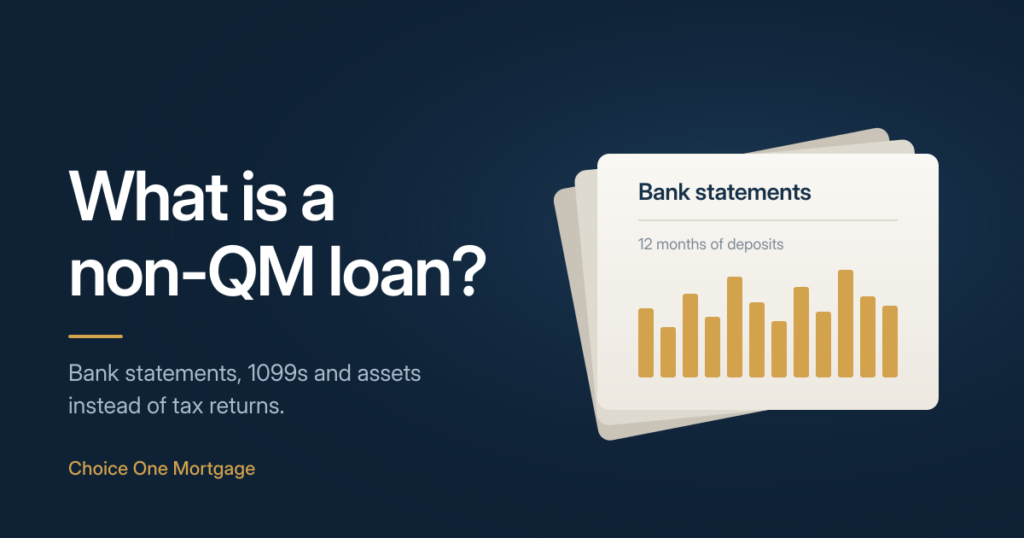
Self-employed individuals often write off significant business expenses on their tax returns, which lowers their reported income on paper — even though their actual cash flow is strong. Traditional lenders use tax returns to verify income, so a business owner earning $200,000 per year might only show $80,000 after deductions. Non-QM lenders can use 12 to 24 months of bank statements instead of tax returns to calculate income, giving self-employed borrowers a much more accurate representation of their true earning power.
Real Estate Investors
Investors purchasing rental properties or growing a portfolio often use DSCR (Debt Service Coverage Ratio) loans. Instead of looking at the borrower's personal income, DSCR loans qualify based on whether the rental income from the property covers the mortgage payment. If the property generates $3,000 per month in rent and the mortgage payment is $2,500, the DSCR is 1.2 — meaning the property more than pays for itself. This is ideal for investors who own multiple properties and whose personal DTI ratios would otherwise disqualify them.
1099 Contractors and Gig Workers
Independent contractors, freelancers, and gig economy workers receive 1099 income rather than W-2s. Non-QM 1099 income programs allow these borrowers to qualify using their 1099 forms directly, without needing full tax returns. This is increasingly relevant as more professionals work as independent consultants, rideshare drivers, or freelance specialists.
Foreign Nationals and ITIN Borrowers
Non-U.S. citizens who work and earn income in the United States but don't have a Social Security number can use an Individual Taxpayer Identification Number (ITIN) to apply for a non-QM mortgage. Foreign national programs are also available for those who want to purchase property in the U.S. as an investment or second home.
Borrowers with Recent Credit Events
Traditional QM loans often require lengthy waiting periods after a foreclosure, bankruptcy, or short sale — sometimes four to seven years. Non-QM programs may allow borrowers to qualify as soon as one day after a credit event, provided they can demonstrate they've recovered financially and can afford the new payment. This is a game-changer for borrowers who experienced financial hardship during economic downturns but have since rebuilt their financial lives.
Retirees and Asset-Rich Borrowers
Asset depletion or asset utilization programs allow borrowers to qualify based on their liquid assets rather than monthly income. If a retiree has $1.5 million in investment accounts but limited monthly income, a non-QM lender can divide those assets over a set period (typically 360 months) to calculate a qualifying monthly income. This makes homeownership accessible for retirees and high-net-worth individuals who may not have traditional employment income.
Types of Non-QM Loan Programs
Non-QM is an umbrella term that encompasses several distinct loan programs. Here are the most common types available through Choice One Mortgage:
- Bank Statement Loans: Use 12 or 24 months of personal or business bank statements to verify income instead of tax returns. Ideal for self-employed borrowers.
- DSCR Loans: Qualify based on the investment property's rental income rather than personal income. No employment verification or personal income documentation required.
- 1099 Income Loans: Use 1099 forms from the past one or two years to document income for independent contractors.
- Asset Depletion Loans: Qualify based on liquid assets divided over the loan term. Designed for retirees and high-net-worth borrowers.
- Interest-Only Loans: Pay only the interest for an initial period (typically 5-10 years), resulting in lower monthly payments during the interest-only phase.
- Recent Credit Event Loans: Available shortly after bankruptcy, foreclosure, or short sale with appropriate compensating factors.
- Foreign National / ITIN Loans: For non-U.S. citizens purchasing property in the United States.
- Jumbo Non-QM Loans: Non-QM programs are available for loan amounts well above conforming limits, sometimes up to $3 million or more.
How Do Non-QM Loans Differ from Conventional Mortgages?
Understanding the key differences between non-QM and conventional (QM) mortgages will help you decide which option is right for your situation:
| Feature | Conventional (QM) Loan | Non-QM Loan |
|---|---|---|
| Income Verification | W-2s, tax returns, pay stubs | Bank statements, 1099s, assets, DSCR |
| DTI Limits | Typically 43-50% | More flexible, varies by program |
| Credit Score | 620+ minimum | Some programs accept 600 or lower |
| Down Payment | 3-20% | Typically 10-25% |
| Interest Rates | Lower, market-based | Slightly higher to offset added risk |
| Waiting Period After Credit Event | 2-7 years | As little as 1 day |
| Employment Verification | Required | Not always required (e.g., DSCR) |
Important Considerations Before Choosing a Non-QM Loan
While non-QM loans offer tremendous flexibility, there are some important factors to weigh before deciding this is the right path for you:
Higher Interest Rates
Non-QM loans generally carry interest rates that are 0.5% to 2% higher than comparable conventional loans. This is because non-QM loans cannot be sold to Fannie Mae or Freddie Mac, so lenders price in additional risk. However, for borrowers who wouldn't qualify for a conventional loan at all, a non-QM loan at a slightly higher rate is far better than not being able to purchase or refinance.
Larger Down Payments
Most non-QM programs require a minimum down payment of 10% to 20%, compared to as little as 3% for conventional loans or 0% for VA loans. The higher down payment requirement helps offset the lender's risk and can also result in better pricing for the borrower.
Reserve Requirements
Many non-QM programs require borrowers to have several months of mortgage payments in reserve (savings) after closing. This demonstrates financial stability and ensures you can continue making payments even if your income fluctuates.
Not All Lenders Offer Non-QM
Non-QM loans are a specialty product, and not every mortgage company or bank offers them. Working with an experienced mortgage broker like Choice One Mortgage gives you access to multiple non-QM lenders, allowing us to shop for the best rates, terms, and programs that fit your specific situation. We work with top non-QM lenders to ensure you get competitive pricing and a smooth closing process.
The Non-QM Loan Application Process
Applying for a non-QM loan follows a similar process to a conventional mortgage, with some differences in documentation:
- Initial Consultation: We'll review your financial situation, income sources, and goals to determine which non-QM program is the best fit.
- Documentation Gathering: Depending on the program, you'll provide bank statements, 1099s, asset statements, a lease agreement (for DSCR), or other alternative documentation.
- Pre-Approval: Once we've reviewed your documents, we'll issue a pre-approval letter so you can shop with confidence.
- Property Selection and Appraisal: After you find a property and go under contract, an appraisal will be ordered to confirm the home's value.
- Underwriting: The lender's underwriting team reviews all documentation and issues a final approval.
- Closing: Sign your documents and receive your keys. Most non-QM loans close within 30 to 45 days.
Non-QM Loans in the Coachella Valley and Southern California
The Coachella Valley and greater Southern California are ideal markets for non-QM lending. The region has a high concentration of self-employed professionals, small business owners, real estate investors, and retirees — all of whom can benefit from non-QM programs. Whether you're purchasing a vacation home in Indian Wells, an investment property in Indio, or your primary residence in La Quinta or Palm Desert, non-QM loans make it possible to finance your goals.
Home prices in many Southern California markets exceed the conforming loan limit of $766,550 for Riverside County, making jumbo non-QM loans particularly relevant for buyers shopping in higher price ranges. Choice One Mortgage offers non-QM jumbo programs for loan amounts up to $3 million and beyond.
Is a Non-QM Loan Right for You?
A non-QM loan may be the right choice if any of the following apply to your situation:
- You're self-employed and your tax returns don't reflect your true income
- You're a real estate investor looking to qualify based on rental income
- You're an independent contractor or gig worker with 1099 income
- You've experienced a recent bankruptcy, foreclosure, or short sale
- You're a retiree with significant assets but limited monthly income
- You're a foreign national or ITIN holder looking to purchase property in the U.S.
- You need a loan amount above conforming limits with flexible documentation
The best way to find out is to speak with an experienced non-QM lender. At Choice One Mortgage, Bill Lewis has over 30 years of experience helping borrowers find the right mortgage solution — even when others have said it couldn't be done.
Ready to explore your non-QM loan options?
Call (800) 224-9999 or (310) 614-5920 for a free, no-obligation consultation.
Contact Us TodayFrequently Asked Questions About Non-QM Loans
What is the minimum credit score for a non-QM loan?
Minimum credit score requirements vary by program. Bank statement loans typically require a 620 or higher, while some DSCR and recent credit event programs may accept scores as low as 580 or even 500 with compensating factors like a larger down payment. At Choice One Mortgage, we work with multiple non-QM lenders to find options that fit your credit profile.
Are non-QM loans the same as subprime loans?
No. While both fall outside conventional lending guidelines, modern non-QM loans are fundamentally different from the subprime loans that contributed to the 2008 financial crisis. Today's non-QM loans are responsibly underwritten, require meaningful down payments, and verify the borrower's ability to repay through alternative documentation methods. They are regulated financial products designed for creditworthy borrowers with non-traditional income.
How much of a down payment do I need for a non-QM loan?
Most non-QM programs require a minimum down payment of 10% to 20%, depending on the loan type, credit score, and property type. DSCR loans for investment properties typically require 20-25% down, while bank statement loans for primary residences may allow as little as 10% down with strong credit and reserves.
Can I refinance a non-QM loan later into a conventional loan?
Yes, many borrowers use non-QM loans as a bridge. For example, a self-employed borrower might use a bank statement loan to purchase a home and then refinance into a conventional loan once they have two years of stronger tax returns. Similarly, a borrower with a recent credit event can use a non-QM loan now and refinance once the waiting period for conventional financing has passed.
What is a DSCR loan and how does it work?
A DSCR (Debt Service Coverage Ratio) loan qualifies borrowers based on the rental income of the investment property rather than personal income. The DSCR is calculated by dividing the property's monthly rental income by the monthly mortgage payment (including taxes and insurance). Most lenders require a DSCR of 1.0 or higher, meaning the rent at least covers the payment. No personal income documentation, tax returns, or employment verification is required.
Does Choice One Mortgage offer non-QM loans in the Coachella Valley?
Yes, Choice One Mortgage offers a full range of non-QM loan programs throughout the Coachella Valley, including La Quinta, Palm Desert, Indio, Indian Wells, Palm Springs, Cathedral City, Rancho Mirage, and surrounding communities. We also serve borrowers across all of Southern California. Contact us at (310) 614-5920 to discuss your options.