
If you've ever been told you can't buy another rental property because your debt-to-income ratio is too high — even though every property you own cash flows just fine — you've run into the central frustration of conventional investment property financing. Traditional lenders look at your tax returns. Real estate investors, especially successful ones, tend to look poor on tax returns. That's the whole point of good tax planning.
DSCR loans solve that problem by asking a completely different question: does the property pay for itself?
Bill Lewis at Choice One Mortgage has spent more than 30 years helping investors finance rental properties throughout the Coachella Valley and Southern California, including buyers in Indio, La Quinta, Palm Desert, Palm Springs, Indian Wells, and Rancho Mirage. In this guide, we'll break down exactly what a DSCR loan is, how the ratio is calculated, what lenders require in 2026, and — critically for desert investors — how the Coachella Valley's patchwork of short-term rental rules affects which properties actually qualify.
What Is a DSCR Loan?
DSCR stands for Debt Service Coverage Ratio. A DSCR loan is a mortgage for investment property that qualifies you based on the property's rental income rather than your personal income.
There are no W-2s. No tax returns. No pay stubs. No employment verification. No personal debt-to-income calculation. The lender underwrites the property's cash flow, your credit, your down payment, and your reserves — and that's essentially it.
DSCR loans fall under the broader non-QM (non-qualified mortgage) umbrella, meaning they sit outside the strict Consumer Financial Protection Bureau guidelines that govern conventional mortgages. That's not a red flag — it's the mechanism that makes the flexibility possible. Because DSCR loans finance business-purpose investment property rather than owner-occupied homes, they aren't subject to the same ability-to-repay documentation rules that apply to a primary residence.
This is why DSCR loans have become the default financing tool for serious portfolio builders. Once you own four or five financed properties, conventional lenders start piling on restrictions and your DTI becomes an immovable ceiling. DSCR lenders generally don't care how many properties you own, as long as each new one carries its own weight.
How Is DSCR Calculated?
The math is refreshingly simple.
DSCR = Monthly Rental Income ÷ Monthly PITIA
PITIA stands for Principal, Interest, Taxes, Insurance, and Association dues (HOA fees). That last "A" matters enormously in the Coachella Valley, where a large share of investment-grade properties sit inside golf and country club communities with meaningful monthly dues.
A Coachella Valley Example
Let's say you're buying a three-bedroom home in Indio for $600,000 with 25% down, financing $450,000.
- Principal and interest at 7.25%: $3,070
- Property taxes (roughly 1.25% annually): $625
- Homeowners insurance: $175
- HOA dues: $250
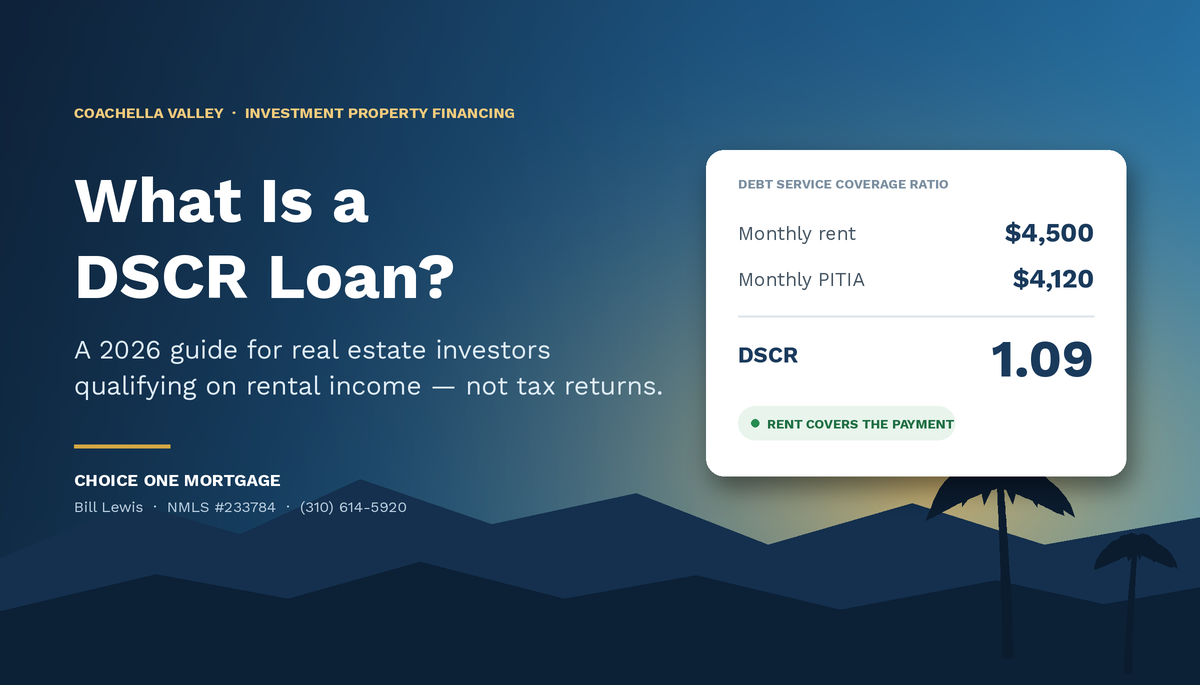
- Total monthly PITIA: $4,120
If the property rents for $4,500 per month on a long-term lease:
$4,500 ÷ $4,120 = 1.09 DSCR
That property qualifies under most DSCR programs, which set the floor at 1.0. But at 1.09 you're near the bottom of the pricing ladder. Push the down payment to 30% and the payment drops enough to move the ratio above 1.20, which typically unlocks a better rate — and often saves more over the life of the loan than the extra cash costs you.
What Your Ratio Actually Means
| DSCR | What It Means | Typical Treatment |
|---|---|---|
| 1.25 or higher | Rent exceeds the payment by 25%+ | Best pricing and maximum leverage |
| 1.00 – 1.24 | Property covers itself | Approvable on nearly all programs |
| 0.75 – 0.99 | Slight monthly shortfall | Available with more down payment and a rate bump |
| Below 0.75 / No Ratio | Property doesn't cover the payment | Specialty programs only; expect 30%+ down and premium pricing |
Yes, "no ratio" DSCR programs exist. They're occasionally the right tool — say, for a Palm Springs property being renovated before it hits the vacation rental market — but they're expensive, and they should be a deliberate choice rather than a fallback.
Wondering whether your property pencils out? Call Bill Lewis at Choice One Mortgage for a free DSCR analysis.
Get a Free Loan AnalysisDSCR Loan Requirements in 2026
Guidelines vary by lender, and because Choice One Mortgage is a broker rather than a single-source lender, we can shop your scenario across multiple DSCR investors to find the program that fits. That said, here's where the market generally sits in 2026:
Minimum DSCR Ratio
Most programs require 1.0 or higher. A 1.25 ratio or better puts you in the top pricing tier. Sub-1.0 options exist with compensating factors.
Credit Score
Minimums typically run 620 to 660 depending on the lender. Credit affects pricing far more than it affects eligibility — scores of 700 and above unlock materially better rates and higher loan-to-value limits. If you're sitting at 690, it's often worth spending 30 to 60 days improving your score before you apply.
Down Payment
Plan on 20% to 25% for a purchase. Investors with 740+ credit and a strong ratio can occasionally find 15%-down programs, but they aren't widely available and they price accordingly. Lower ratios, lower scores, or no landlord history push the requirement toward 25% to 30%.
Cash Reserves
Most lenders want roughly six months of PITIA in liquid reserves after closing, and some scale that requirement up based on how many financed properties you own. This is the requirement first-time DSCR borrowers most often overlook — they budget carefully for the down payment and closing costs, then get caught short on the cushion behind them.
Property Type
Single-family homes, condos, townhomes, and 2-4 unit properties are all standard. Many programs also handle 5-10 unit multifamily and short-term rentals. Warrantable and non-warrantable condos are both financeable, though non-warrantable condos — common in older desert resort communities — narrow the lender list.
Entity Vesting
Most DSCR lenders allow you to take title in an LLC, which is one of the product's underrated advantages. Conventional investment loans generally require personal vesting. If you're structuring holdings for liability protection, DSCR financing lets you do it at closing rather than transferring title afterward and triggering a due-on-sale clause.
Loan Amounts
DSCR programs commonly run from around $100,000 up to $3 million or more. That's meaningful in this market: Riverside County's 2026 conforming loan limit is $832,750, and plenty of Coachella Valley investment properties — particularly in Palm Springs, Rancho Mirage, and Indian Wells — sit well above it.
Prepayment Penalties
This one deserves your full attention. Most DSCR loans carry a prepayment penalty, commonly structured over three to five years, sometimes as a step-down (5%/4%/3%/2%/1%) and sometimes as a flat percentage. You can usually buy the penalty down or eliminate it entirely in exchange for a higher rate. If you plan to hold the property long term, accepting the penalty and taking the lower rate is often the better math. If you might sell or refinance within three years, pay for the flexibility.
DSCR Loan Rates in 2026
DSCR rates in 2026 have generally been running in the 6.5% to 8% range for residential investment property, with well-qualified borrowers landing at the lower end. That's roughly 0.5% to 1.5% above conventional owner-occupied pricing.
Here's the nuance most articles miss: conventional loans on investment property carry agency loan-level price adjustments that already add roughly 0.5% to 0.75% over the owner-occupied rates you see advertised. So the real gap between a conventional investor loan and a DSCR loan is much narrower than the headline comparison suggests — and for many investors it's close enough that the documentation savings alone justify the product.
Your specific rate depends on credit score, loan-to-value, DSCR ratio, loan size, reserves, whether you accept a prepayment penalty, and whether you choose a fixed or ARM structure. Rates move with the bond market, so treat any published range as a snapshot rather than a quote. Check current rates or contact us for pricing on your actual scenario.
DSCR Loans vs. Conventional Investment Property Loans
| Feature | Conventional Investment Loan | DSCR Loan |
|---|---|---|
| Income Documentation | Tax returns, W-2s, pay stubs | None — property income only |
| Employment Verification | Required | Not required |
| Personal DTI Calculation | Yes, typically capped at 45-50% | Not calculated |
| Limit on Financed Properties | Generally 10 | Usually unlimited |
| Vesting | Personal name required | LLC or personal name |
| Down Payment | 15-25% | 20-25% (occasionally 15%) |
| Interest Rate | Lower, but with investor LLPAs | Roughly 0.5-1.5% higher |
| Prepayment Penalty | None | Common; buyable |
| Typical Closing Time | 30-45 days | 21-30 days |
| Loan Limit | $832,750 in Riverside County | Up to $3M+ |
Using a DSCR Loan in the Coachella Valley
This is where local expertise stops being a marketing line and starts being the difference between a closed loan and a wasted escrow deposit.
The Coachella Valley is one of the most attractive rental investment markets in Southern California — nine cities, a winter season that fills every hotel from Palm Springs to Indio, and a calendar of events (Coachella, Stagecoach, the BNP Paribas Open, Modernism Week, the American Express golf tournament) that drives extraordinary seasonal demand. It's also one of the most regulatorily fragmented markets in the state. Every city treats short-term rentals differently, and those differences directly determine how a DSCR lender will underwrite your income.
Short-Term Rental Rules Vary Dramatically by City
If your DSCR calculation depends on nightly rental income, the property must be legally permitted to operate as a short-term rental. Underwriters verify this. Here's the general lay of the land as of 2026 — but confirm current rules with the city before you write an offer, because these ordinances change frequently:
- Palm Springs: The most established short-term rental market in the valley. Requires a city vacation rental certificate, operates under a neighborhood density cap of roughly 20%, and limits the number of rentals per year depending on zone. A junior permit option exists at reduced cost with a lower rental cap.
- La Quinta: A permanent ban on new short-term rental permits outside specifically zoned areas has been in place since 2020, with more than 1,100 existing permits grandfathered. Home share permits are available where new full STR permits are not. Buying an existing permitted property is generally the only path in.
- Rancho Mirage: Citywide prohibition on short-term rentals in residential areas.
- Cathedral City: Short-term rentals phased out in most residential zones, with the Resort Residential zone as the primary exception.
- Palm Desert: Zone-restricted, with a moratorium affecting Planned Residential zones. HOA written approval is required where the community permits STRs.
- Indian Wells: A 29-night minimum stay applies, with a limited seven-night exception around the tennis tournament.
- Indio: Permits required through the city's short-term rental program, with active compliance enforcement.
- Coachella: Permits required, with transient occupancy tax applied.
- Desert Hot Springs: Operates under a citywide cap of roughly 4% of housing stock, plus spacing requirements between permitted properties.
The practical takeaway: a permit is not transferable everywhere, and in some cities it doesn't exist at all. We've seen investors go under contract on a beautiful Rancho Mirage property with a vacation rental pro forma, only to discover the city doesn't allow the use. Verify the permit status and jurisdiction — by parcel, not by neighborhood name — before you commit.
How Lenders Underwrite Short-Term Rental Income
Long-term rental income is straightforward: the appraiser completes a Form 1007 rent schedule (or Form 1025 for 2-4 units) establishing market rent, and the lender generally uses the lower of the appraiser's market rent or the actual lease.
Short-term rental income is more involved. Programs that allow it typically require one of the following:
- 12 months of documented rental history from the property, verified through platform statements (Airbnb, Vrbo) or a property manager's ledger.
- Third-party market data, most commonly an AirDNA report for the specific address, sometimes haircut by 10-25%.
- A blended approach, using the lower of the STR projection and the long-term market rent.
Not every DSCR lender permits short-term rental income at all. This is one of the clearest reasons to work with a broker in this market — placing a Palm Springs vacation rental with a lender that only counts long-term rents will sink an otherwise strong deal.
The Seasonality Problem — and How to Handle It
Coachella Valley rental income is not evenly distributed across the year. A Palm Desert property might command $6,000 a month from January through April and sit largely empty in August. Annual revenue can be excellent; monthly consistency is not.
Underwriters handle this by annualizing, but the way your documentation presents that math matters. A few things that help:
- Provide a full 12 months of history so the summer trough is contextualized by the winter peak rather than looking like a vacancy problem.
- Consider a "snowbird" seasonal lease structure — four to six month furnished tenancies to winter residents, which many desert investors find produces steadier underwriting-friendly income than nightly rentals, with far less regulatory exposure.
- Keep reserves above the minimum; carrying a property through a desert summer is a real cost, and lenders know it.
HOA Dues Are Not a Footnote Here
In most markets, HOA fees are a minor line item. In the Coachella Valley, where a large share of investment inventory sits in golf and country club communities, dues can run $400 to $1,200 per month or more — and in some clubs, membership fees are mandatory on top of that.
Because HOA dues are part of PITIA, they hit your DSCR directly. A $700 monthly HOA payment can swing a ratio from 1.15 to 0.95 and change your entire loan structure. Before making an offer in a country club community, get the actual dues figure — including any mandatory club membership or capital contribution — and run the ratio. We'll do this with you at no cost, and it takes about ten minutes.
One more HOA consideration: many desert HOAs restrict rentals to 30 days or longer, and some impose minimum ownership periods before you're permitted to rent at all. The CC&Rs govern regardless of what the city allows.
2026 Coachella Valley Market Snapshot
Recent Greater Palm Springs Realtors desert housing data shows meaningful price variation across the valley, which creates genuinely different investment profiles city by city. Approximate median values in early 2026:
| City | Approximate Median Value | Investor Profile |
|---|---|---|
| Coachella | ~$488,000 | Highest cash-flow potential; strongest long-term rental ratios |
| Cathedral City | ~$553,000 | Affordable entry; STR limited to Resort Residential |
| Indio | ~$627,000 | Strong long-term rental demand; event-driven seasonal upside |
| Palm Desert | ~$735,000 | Deep tenant pool; zone-restricted STR |
| La Quinta | ~$892,000 | Premium market; existing STR permits carry real value |
| Palm Springs | ~$1,103,000 | Best STR framework; requires larger loan amounts |
| Rancho Mirage | ~$1,408,000 | Long-term and seasonal leases only |
| Indian Wells | ~$2,228,000 | Luxury; 29-night minimum shapes strategy |
Prices across much of the valley have softened from their 2022 peaks while rents have held comparatively firm — a combination that has improved DSCR ratios in several submarkets relative to two years ago. For investors who were priced out during the pandemic run-up, 2026 is a more workable entry point than 2022 was.
Note that Palm Springs, Rancho Mirage, and Indian Wells medians all sit above the $832,750 conforming limit, meaning conventional financing isn't even on the table for many of those purchases. DSCR programs handle these loan sizes routinely.
How to Improve Your DSCR Before You Apply
If your ratio comes in below where you want it, you have more levers than most investors realize:
- Increase the down payment. The most direct lever. Adding 5% down lowers the payment the rent has to cover and frequently improves your rate at the same time.
- Consider an interest-only structure. Many DSCR programs offer interest-only periods. Because the qualifying payment is lower, the ratio improves — sometimes substantially. Understand the trade-off: no principal paydown during the IO period.
- Buy down the rate. Discount points lower the payment and lift the ratio. Run the breakeven before committing.
- Choose a 40-year term. Some programs offer 40-year amortization, reducing the monthly payment and improving the ratio.
- Shop the insurance. Desert properties can be quoted inconsistently across carriers. A $60 monthly difference in premium moves the ratio more than most people expect.
- Furnish the unit. In this market, furnished properties command meaningfully higher rents — particularly for seasonal tenancies. A documented furnished lease can lift the appraiser's market rent conclusion.
- Reconsider the HOA. A comparable property in a non-HOA neighborhood or a community with lower dues may produce a stronger ratio at a similar purchase price.
The DSCR Loan Process, Step by Step
- Initial Consultation: We review the property, the projected rent, your credit profile, available funds, and your hold strategy — then identify which DSCR programs fit.
- Pre-Approval: Because there's no income documentation to gather, DSCR pre-approvals move quickly. We typically need a credit authorization, asset statements, and details on the subject property.
- Property Under Contract: Once you're in escrow, we order the appraisal along with the rent schedule (Form 1007 or 1025) that establishes market rent.
- Rental Income Verification: For a leased property, we collect the lease. For a short-term rental, we gather platform history or market data. For a vacant property, the appraiser's market rent conclusion carries the file.
- Underwriting: The lender verifies the ratio, credit, reserves, entity documents if you're vesting in an LLC, and the property's legal rental status.
- Closing: Most DSCR loans close in 21 to 30 days — faster than conventional, largely because there's no income documentation to chase.
Common Mistakes Coachella Valley Investors Make
- Assuming a short-term rental permit transfers with the sale. In some cities it does; in others it absolutely does not. Verify with the city, in writing, during your contingency period.
- Building a pro forma on peak-season rents. January through April numbers are not annual numbers. Underwriters annualize, and so should you.
- Leaving HOA dues out of the ratio. The "A" in PITIA is not optional, and in this market it's often the largest variable.
- Ignoring the prepayment penalty. If you're planning a value-add and a quick refinance, a five-year penalty can cost you far more than the rate savings gained you.
- Underestimating desert-specific operating costs. Pool service, HVAC in extreme summer heat, landscaping, and higher summer utility loads on vacant units all affect real returns, even though the lender only underwrites PITIA.
- Not checking the CC&Rs. City approval means nothing if the HOA prohibits the rental term you're planning.
Is a DSCR Loan Right for You?
A DSCR loan is likely a strong fit if any of these describe your situation:
- You're self-employed and your tax returns understate your actual income
- Your debt-to-income ratio disqualifies you from conventional financing despite strong cash flow
- You already own several financed properties and have hit conventional limits
- You want to hold title in an LLC
- You're buying above the $832,750 Riverside County conforming limit
- You need to close quickly to win a competitive offer
- You're a foreign national investing in U.S. property
- You simply don't want to document personal income for a business-purpose loan
A DSCR loan is probably not the right tool if you're buying a primary residence, if the property's ratio is well below 1.0 with no path to improve it, or if you're planning to sell within a year or two and can't get comfortable with a prepayment penalty.
Bill Lewis and the team at Choice One Mortgage have been financing Southern California real estate for more than three decades. As a broker, we shop your DSCR scenario across multiple wholesale lenders rather than fitting you into a single institution's box — which matters enormously on a product where guidelines vary this widely from lender to lender.
Ready to run the numbers on your next Coachella Valley investment property?
Call (800) 224-9999 or (310) 614-5920 for a free, no-obligation DSCR analysis.
Contact Us TodayFrequently Asked Questions About DSCR Loans
What is a good DSCR ratio?
A DSCR of 1.0 means the rental income exactly covers the full mortgage payment including taxes, insurance, and HOA dues. Most lenders treat 1.0 as the minimum, but 1.25 or higher is considered strong and typically earns the best interest rates and highest loan-to-value limits. Ratios below 1.0 are financeable through specialty programs with a larger down payment and higher rate.
Do DSCR loans require a down payment?
Yes. Plan on 20% to 25% for a purchase. Some lenders offer 15% down for borrowers with credit scores above 740 and a DSCR above 1.25, though those programs aren't widely available. On a cash-out refinance there's no down payment — your existing equity serves the same purpose, with most programs allowing up to 70-75% loan-to-value.
What credit score do I need for a DSCR loan?
Most DSCR programs start at a 620 to 660 minimum FICO. Credit affects your pricing and leverage far more than your eligibility — 700 or above generally unlocks the best rates, and 720+ puts you in the top tier. Because Choice One Mortgage works with multiple DSCR lenders, we can often find a home for scenarios that a single lender would decline.
Can I use a DSCR loan for a short-term or vacation rental?
Yes, many DSCR programs allow short-term rental income — but not all of them, and the property must be legally permitted for that use. Lenders typically require 12 months of documented rental history or a third-party market analysis such as an AirDNA report. In the Coachella Valley this is especially important because short-term rental rules differ substantially between Palm Springs, La Quinta, Palm Desert, Rancho Mirage, Indian Wells, and the other desert cities.
Can I get a DSCR loan in an LLC?
Yes. Most DSCR lenders allow title to be held in an LLC or other business entity, which is one of the product's key advantages over conventional investment financing. You'll need to provide the operating agreement, articles of organization, and a certificate of good standing. Individual vesting is also permitted if you prefer.
Are DSCR loan rates much higher than conventional rates?
The gap is narrower than most investors assume. DSCR rates in 2026 have generally run about 0.5% to 1.5% above conventional owner-occupied pricing — but conventional investment property loans already carry agency pricing adjustments of roughly 0.5% to 0.75%. Compared apples to apples against a conventional investor loan, the DSCR premium is often modest.
How many DSCR loans can I have at once?
Most DSCR lenders don't limit the number of financed properties, which is a major departure from conventional guidelines that generally cap investors at ten. Some programs increase reserve requirements as your portfolio grows, and individual lenders may cap total exposure to a single borrower — usually a threshold most investors never approach.
Do DSCR loans have prepayment penalties?
Most do, typically structured over three to five years. You can usually reduce or eliminate the penalty by accepting a higher interest rate. Whether that trade makes sense depends entirely on your hold period — worth modeling both ways before you lock.
How is DSCR calculated on a property that's currently vacant?
The appraiser completes a Form 1007 comparable rent schedule establishing market rent for the property, and the lender uses that figure. You don't need a signed lease in place to close, which is helpful when you're buying a property that needs work before it goes on the rental market.
Does Choice One Mortgage offer DSCR loans in the Coachella Valley?
Yes. Choice One Mortgage arranges DSCR financing throughout the Coachella Valley, including La Quinta, Palm Desert, Indio, Indian Wells, Palm Springs, Rancho Mirage, Cathedral City, and Bermuda Dunes, as well as across Southern California. Contact us at (310) 614-5920 to discuss your scenario.
Related Articles
- Denied for a HELOC? Here's how to Qualify
- Try our Purchase Loan Estimator
- See all mortgage products
- Learn about non-QM loans

About the Author: Bill Lewis
Mortgage Loan Originator, Choice One Mortgage · NMLS #284797
Bill Lewis has spent more than 30 years helping Southern California homeowners find financing that fits their real situation — including borrowers who've been turned down elsewhere. Based in La Quinta, Choice One Mortgage serves homeowners throughout the Coachella Valley, Ventura County, and the South Bay. Learn more about our team or call (310) 614-5920.
Rates, guidelines, and municipal short-term rental ordinances change frequently. The figures in this article reflect general market conditions and are for educational purposes only — they are not a commitment to lend or a quote. Verify current city rental regulations directly with the applicable municipality before purchasing. COMC, Inc. dba Choice One Mortgage Company. Licensed by the CA DRE #01238593. NMLS #233784.