
You found the condo. Your credit is strong, your down payment is ready, and your pre-approval is in hand. Then, three weeks into escrow, the lender comes back and says the loan cannot be made — not because of anything about you, but because of the building.
This is one of the most frustrating ways a purchase falls apart, and it happens more often now than it did a year ago. In 2026 Fannie Mae and Freddie Mac tightened their condominium project standards significantly, and the biggest change took effect this past August. Bill Lewis at Choice One Mortgage has financed condominiums across the Coachella Valley, Ventura County, and the South Bay for more than 30 years. This guide explains what warrantability means, what changed, why it matters especially in Southern California's resort and country club communities, and what to do if a project does not qualify.
What "Warrantable" Actually Means
When you buy a condominium, the lender is not only underwriting you. It is also underwriting the project — the association's finances, its insurance, its legal standing, and its physical condition.
A project that meets Fannie Mae's and Freddie Mac's standards is called warrantable. Loans in a warrantable project can be sold to the agencies after closing, which is what makes conventional pricing and low down payments possible. A project that fails any single one of those standards is non-warrantable. Financing is still available, but it comes from portfolio and non-QM lenders instead, usually with a larger down payment and a higher rate.
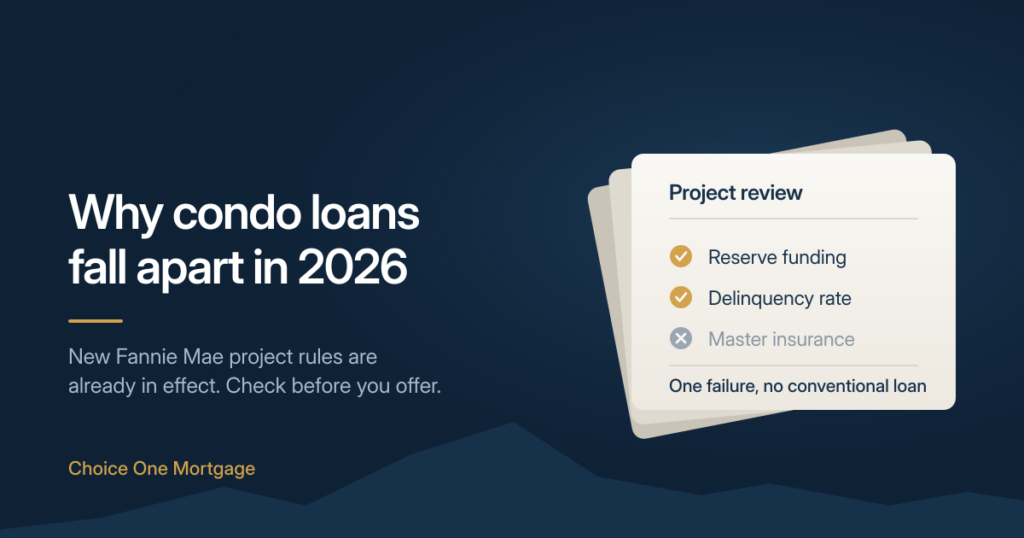
The critical detail is that these criteria are not scored or weighted. Failing one is enough. An association can have healthy reserves, no litigation, and a spotless delinquency record, and still lose warrantable status because of a single line in its insurance policy.
What Changed in 2026
On March 18, 2026, Fannie Mae issued Lender Letter LL-2026-03 and Freddie Mac published a matching bulletin, coordinated with each other and with the Federal Housing Finance Agency. The changes rolled out on a staggered schedule, and most of them are already live.
| Effective Date | What Changed | Effect on Buyers |
|---|---|---|
| March 18, 2026 | The 50% investor concentration cap for Full Review was eliminated; project review waivers expanded to projects of 10 or fewer units | Helpful — investor-heavy projects are no longer disqualified on that basis alone |
| July 1, 2026 | Master policy per-unit deductible capped at $50,000; unit owner policies required in more situations | Restrictive — associations that raised deductibles to control premiums can fail |
| August 3, 2026 | Limited Review retired for established projects with more than 10 units | Restrictive — every loan now requires Full Review, meaning more documents and more scrutiny |
| January 4, 2027 | Minimum reserve contribution rises from 10% to 15% of annual budgeted assessment income | Restrictive — projects passing today may not pass in January |
The Retirement of Limited Review Is the One You Will Feel
Limited Review was a streamlined path that let lenders approve a condo loan on a shorter set of questions when the borrower had significant equity. For established projects of more than 10 units, that path is gone as of August 3, 2026.
Everything now goes through Full Review, which means the lender must obtain and evaluate the association's budget, financial statements, reserve study, delinquency data, meeting minutes, insurance documents, litigation status, and any pending special assessments. Two things follow. First, it takes longer. Second, and more importantly, an underwriter now looks at documents that used to go unexamined — which means problems that would previously have gone unnoticed surface in the middle of your escrow.
The Insurance Change Deserves Its Own Warning
For loan applications dated on or after July 1, 2026, a project's master policy per-unit deductible cannot exceed $50,000. Master coverage must also be written at replacement cost.
This matters enormously in California right now. Associations facing steep premium increases have often responded by raising deductibles, because that is the fastest way to hold the annual premium down. That reasonable-looking budget decision can now make an entire project non-warrantable. If you are buying a condo in California in 2026, the master policy declarations page is one of the first documents worth looking at.
What Makes a Project Non-Warrantable
These are the criteria that most often cause a project to fail. Any one of them is enough.
- Underfunded reserves: less than 10% of annual budgeted assessment income allocated to reserves, or failure to fund at the level a current reserve study recommends. This threshold rises to 15% for applications dated on or after January 4, 2027.
- Delinquent assessments: 15% or more of units 60 or more days behind on HOA dues.
- Single-entity ownership: one owner or entity holding more than 20% of the units in a project of 21 or more units.
- Master insurance problems: coverage below replacement cost, or a per-unit deductible above $50,000.
- Too much commercial space: more than 35% of the project's total square footage in non-residential use.
- Hotel-like operations: projects run as resorts, with rental desks, daily or short-term rental programs, or shared revenue arrangements.
- Critical repairs and deferred maintenance: unresolved structural or safety issues, or an inspection report identifying critical repairs that have not been addressed.
- Litigation: pending suits involving safety, structural soundness, or habitability.
- Presale requirements: in new or newly converted projects, an insufficient share of units sold to owner-occupants or second-home buyers.
Looking at a condo and not sure the project qualifies? Call Bill Lewis at Choice One Mortgage before you write the offer.
Get a Free Loan AnalysisWhy This Hits the Coachella Valley Harder Than Most Markets
Warrantability is a national standard, but its effects are intensely local, and the desert has a concentration of exactly the characteristics that cause projects to fail.
Resort-Style Operations
A great deal of condominium inventory in La Quinta, Palm Desert, and Indian Wells was built around golf and resort use. Where a project operates a rental desk, participates in a hotel-style rental program, or shares rental revenue with owners, it can be classified as a condotel and fall outside conventional financing entirely. This is not about whether individual owners rent their units; it is about how the project itself is organized and operated.
Seasonal Occupancy and Second Homes
The elimination of the 50% investor concentration cap in March 2026 was genuinely good news for the valley, where a high share of units are second homes or rentals. That particular obstacle is gone for Full Review. But high second-home concentration often travels with the other issues on the list — resort operations, amenity-heavy budgets, and reserve strain — so it is worth checking rather than assuming.
Insurance Pressure on HOA Budgets
California associations have been squeezed hard by the property insurance market, and raising the master policy deductible has been a common response. With the $50,000 per-unit cap now in force, that decision can quietly take a project out of conventional financing. If you are curious how the broader insurance market is affecting home purchases here, our guide to homeowners insurance and mortgage approval covers it in depth.
The Same Issues Appear in the South Bay
Older beach-area condominium buildings in Redondo Beach, Hermosa Beach, and San Pedro face their own version of this: deferred maintenance, reserve studies that were never updated, and mixed-use ground floors that can push a project past the 35% commercial threshold.
If the Project Is Non-Warrantable, You Still Have Options
Non-warrantable does not mean unfinanceable. It means the loan cannot be sold to Fannie Mae or Freddie Mac, so it has to be held by a portfolio lender or placed with a non-QM investor. That changes the terms.
Expect a larger down payment. Portfolio and non-QM lenders reviewing non-warrantable condos in 2026 have commonly capped loan-to-value somewhere in the 70% to 80% range, which means 20% to 30% down. Expect a higher rate as well, and read the term sheet carefully — some programs exclude condo-hotels or projects with short-term rental operations outright, so the specific reason a project failed determines which lenders will even look at it.
The first step is always diagnosing why. A reserve shortfall may be correctable with a board budget amendment before your loan application is dated. Hotel-style operations, excessive commercial space, unresolved critical repairs, and safety litigation are much harder to work around, and in those cases a non-QM path is usually the realistic answer. Our guide to non-QM loans explains how those programs work.
What to Do Before You Write an Offer
Warrantability problems are far cheaper to discover early. Before your offer, or at the very latest in the first days of escrow:
- Ask whether the project is on Fannie Mae's ineligible list. Some projects have already been reviewed and flagged, and this takes minutes to check.
- Request the master insurance declarations page and look at the per-unit deductible and whether coverage is written at replacement cost.
- Request the current budget and the reserve study. Check the reserve allocation as a percentage of assessment income, and check the date of the study.
- Ask about special assessments, pending litigation, and any inspection reports identifying repairs that have not been completed.
- Ask how the project handles rentals. Specifically, whether there is a rental desk or a shared-revenue rental program, which is the condotel question.
- Send all of it to your loan officer before you remove contingencies. This is the single most valuable thing you can do.
A cooperative HOA management company can usually produce this package quickly. A management company that resists is itself a useful signal.
A Note for HOA Boards and Sellers
If you own in or serve on the board of a condominium association, warrantability is a property value issue. A project that loses warrantable status shrinks its own buyer pool to cash purchasers and borrowers who can put 20% to 30% down, which shows up in sale prices.
Two dates are worth putting on the board calendar. The master policy deductible cap has been in force since July 1, 2026. And the reserve contribution threshold rises from 10% to 15% for loan applications dated on or after January 4, 2027, which means budgets adopted this fall determine whether buyers can get conventional financing next year. An association that either commissions a current reserve study and funds to its recommendation, or budgets 15% of assessment income to reserves, protects every owner's ability to sell.
Buying a condo in the Coachella Valley or Southern California?
Call (800) 224-9999 or (310) 614-5920 and we will review the project before you are under contract.
Contact Us TodayFrequently Asked Questions About Condo Warrantability
What does it mean if a condo is non-warrantable?
A non-warrantable condo is one whose project fails at least one of Fannie Mae's or Freddie Mac's project eligibility standards, which means a conventional loan on a unit there cannot be sold to the agencies. Financing is still available through portfolio and non-QM lenders, but it generally requires a larger down payment, commonly 20% to 30%, and carries a higher interest rate. The criteria are pass or fail rather than weighted, so a project can fail on a single issue while meeting every other standard.
What changed for condo loans in 2026?
Fannie Mae issued Lender Letter LL-2026-03 on March 18, 2026, with Freddie Mac publishing a matching bulletin. The 50% investor concentration cap for Full Review was eliminated and project review waivers expanded to projects of 10 or fewer units. Effective July 1, 2026, master policy per-unit deductibles are capped at $50,000. Effective August 3, 2026, Limited Review was retired for established projects with more than 10 units, so all such loans now require Full Review. The minimum reserve contribution rises from 10% to 15% of annual budgeted assessment income for applications dated on or after January 4, 2027.
How do I find out if a condo is warrantable before I make an offer?
Ask your lender to check whether the project appears on Fannie Mae's ineligible project list, then request the association's master insurance declarations page, current budget, reserve study, delinquency report, and disclosure of any pending litigation or special assessments. Also ask whether the project operates a rental desk or shared-revenue rental program, which can classify it as a condotel. Getting these documents to your loan officer before you remove contingencies is the most effective way to avoid losing your earnest money.
Why are so many Coachella Valley condos non-warrantable?
The desert has a high concentration of the specific characteristics that cause projects to fail. Many condominium developments in La Quinta, Palm Desert, and Indian Wells were built around golf and resort use, and projects operating rental desks or hotel-style rental programs can be classified as condotels, which falls outside conventional financing. Rising California insurance costs have also pushed many associations to raise master policy deductibles, which can now break the $50,000 per-unit cap. The good news is that the 50% investor concentration cap, long a problem for second-home-heavy projects, was eliminated in March 2026.
Can a condo project fix its warrantability status?
Sometimes. Reserve funding shortfalls can often be corrected by amending the association's budget, and an insurance deductible can be brought back under the cap at renewal. Those changes need to be in place before your loan application is dated. Structural issues, unresolved critical repairs, safety-related litigation, excessive commercial space, and hotel-style operations are much harder to remedy and generally require a non-QM or portfolio loan instead.
Does FHA have its own condo approval process?
Yes. FHA maintains a separate condominium approval process with its own project list and criteria, distinct from Fannie Mae and Freddie Mac warrantability. A project can be approved by one and not the other. FHA also offers a single-unit approval option in some circumstances for projects that are not fully approved. If you are considering an FHA loan on a condominium, confirm the project's FHA status specifically rather than assuming its conventional status carries over.
Does Choice One Mortgage finance non-warrantable condos?
Yes. As a mortgage broker we work with both agency lenders and portfolio and non-QM investors, so we can pursue conventional financing where a project qualifies and place the loan elsewhere where it does not. We also review project documents before you are under contract, which is usually what determines whether a condo purchase closes smoothly. Call (310) 614-5920 to discuss a specific property.