
When a seller is willing to negotiate, the question isn't only whether to ask for a seller concession. It's how to use it. The same $15,000 can lower a buyer's payment for two years, lower it for thirty years, or reduce what they bring to closing. The right choice can be worth thousands of dollars to your client.
When rates are elevated, most buyers don't plan to keep their rate forever. Many expect to refinance if rates fall. That expectation should drive how the seller's money is spent. Money spent on a permanently lower rate only pays off if the buyer keeps the loan. Money spent on a temporary buydown or closing costs pays off right away.
Bill Lewis at Choice One Mortgage has spent more than 30 years helping buyers and their Realtors throughout the Coachella Valley and Southern California, including Indio, La Quinta, Palm Desert, Palm Springs, Indian Wells, and Rancho Mirage. In this guide, we'll compare every major way to use a seller concession with real numbers, and give you a playbook to use with your clients before the offer goes in.
Quick answer: When rates are elevated and a buyer is likely to refinance, the best use of a seller concession is usually a 2-1 temporary buydown, with anything left over going to closing costs. Discount points make sense mainly for buyers who need a lower rate to qualify or who plan to keep the loan long term.
The Example Deal
The rates and pricing in this article are used for example purposes only. Actual rates and point costs change daily and depend on each borrower's situation.
| Deal Detail | Amount |
|---|---|
| Purchase price | $500,000 |
| Down payment (10%) | $50,000 |
| Loan amount | $450,000 (30-year fixed, conventional) |
| Market ("par") rate | 7.125% |
| Principal & interest at par | $3,031.73/month |
| Seller concession negotiated | $15,000 (3% of price) |
Seller Concession Limits by Loan Type
A seller concession, also called a seller credit or seller-paid closing costs, is capped by loan type. Lenders call it an interested party contribution. Any amount over the cap is lost or has to reduce the price. Current limits are:
- Conventional (primary or second home): 3% with less than 10% down, 6% with 10% to 25% down, and 9% with more than 25% down.
- Conventional investment property: 2%.
- FHA: 6%.
- VA: 4% in concessions (buydowns count toward it), with normal closing costs allowed on top.
Concessions can pay for closing costs, prepaids, and rate buydowns. They can't go toward the down payment or reserves, or come back to the buyer as cash. For conventional loans, these rules come from Fannie Mae's guidelines on interested party contributions. Guidelines can change, so confirm current limits with your lender.
Writing an offer with a seller concession? Call us first and we'll run your buyer's options side by side.
Talk to Bill Lewis TodayOption 1: Use the Seller Concession for a Temporary Buydown (2-1 or 3-2-1)
A temporary buydown lowers the rate for the first year or years, then steps up to the permanent note rate. The seller's money goes into an escrow account at closing and covers the payment difference each month.
2-1 Buydown
The rate is 5.125% in year 1, 6.125% in year 2, and 7.125% after that.
| Year | Rate | Monthly P&I | Monthly Savings | Annual Savings |
|---|---|---|---|---|
| 1 | 5.125% | $2,450.19 | $581.54 | $6,978.50 |
| 2 | 6.125% | $2,734.25 | $297.49 | $3,569.83 |
| 3 to 30 | 7.125% | $3,031.73 | $0 | $0 |
| Total cost | $10,548.33 |
That leaves about $4,452 of the concession for closing costs.
3-2-1 Buydown
The rate is 4.125% in year 1, 5.125% in year 2, 6.125% in year 3, and 7.125% after that.
| Year | Rate | Monthly P&I | Annual Savings |
|---|---|---|---|
| 1 | 4.125% | $2,180.92 | $10,209.71 |
| 2 | 5.125% | $2,450.19 | $6,978.50 |
| 3 | 6.125% | $2,734.25 | $3,569.83 |
| Total cost | $20,758.05 |
The 3-2-1 costs about 4.2% of the price, more than our $15,000 concession covers. That's a reason to ask for a bigger concession when the loan type allows it.
The Maximum Temporary Strategy
With 10% or more down, conventional loans allow up to 6% in concessions. On this deal, that's $30,000:
| Use | Cost |
|---|---|
| 3-2-1 buydown | $20,758.05 |
| Toward closing costs and prepaids | $9,241.95 |
| Total | $30,000 |
The buyer starts at a $2,180.92 payment in year one, brings less cash to closing, and has three years for rates to come down.
Two Things Buyers Often Miss
- Buyers still qualify at the full note rate (7.125%). A temporary buydown lowers the early payments but doesn't help a buyer who's tight on debt-to-income.
- That rule is also a safety net. If rates don't fall and the payment steps up to $3,031.73, that payment was already underwritten as affordable.
Option 2: A Permanent Buydown (Discount Points)
Read this one with a caution flag. Discount points are a bet that the buyer keeps the loan past the break-even point. If rates drop and the buyer refinances, most of that money is lost.
Here the concession pays discount points to lower the rate for the life of the loan. Each point costs 1% of the loan amount, which is $4,500 on this deal.
| Points | Cost | Rate | Monthly P&I | Monthly Savings | Break-Even |
|---|---|---|---|---|---|
| 0 (par) | $0 | 7.125% | $3,031.73 | — | — |
| 1 | $4,500 | 6.875% | $2,956.18 | $75.55 | About 60 months |
| 2 | $9,000 | 6.625% | $2,881.40 | $150.33 | About 60 months |
| 3 | $13,500 | 6.50% | $2,844.31 | $187.43 | About 72 months |
Cumulative Savings for 2 and 3 Points
| Time in Loan | 2 Points ($9,000) | 3 Points ($13,500) |
|---|---|---|
| 2 years | $3,608 | $4,498 |
| 5 years | $9,020 | $11,246 |
| 10 years | $18,040 | $22,491 |
| 30 years | $54,120 | $67,474 |
Points still have a place. They're the only buydown that lowers the qualifying rate, so they can help a buyer who is tight on debt-to-income. But when most buyers expect to refinance within a few years, the break-even point is a hard target to reach.
Points Buy Less Than Most Buyers Expect
Many buyers hear "use the seller's money to buy down the rate" and picture a big drop. In this example, spending $13,500, nearly the entire concession, lowers the rate by just 0.625%, from 7.125% to 6.50%. That saves $187 a month.
Each additional point also buys less than the one before:
| Point | Rate Reduction | Added Monthly Savings | Break-Even on That Point |
|---|---|---|---|
| 1st | 0.25% | $75.55 | About 5 years |
| 2nd | 0.25% | $74.78 | About 5 years |
| 3rd | 0.125% | $37.10 | About 10 years |
The third point costs the same $4,500 as the first two but saves half as much. Compare that to the 2-1 buydown: for about $10,500, it cuts the year-one rate by a full 2% and saves $581 a month.
Option 3: Cover Closing Costs and Keep Cash in the Bank
Sometimes the best use of the money is the least exciting one. If closing costs and prepaids run $12,000 to $15,000, the concession can cover nearly all of them. The buyer keeps that cash for reserves, repairs, or an emergency fund.
This matters more when refinancing is part of the plan, because refinancing costs money too. A buyer who closes with healthy savings is in a better position to act when rates drop.
Option 4: The Hybrid
You don't have to choose one strategy. Here's one combination with the same $15,000:
| Use | Cost |
|---|---|
| 1 point permanent (7.125% to 6.875%) | $4,500 |
| 1-0 temporary buydown (5.875% in year 1, then 6.875%) | $3,531 |
| Toward closing costs | $6,969 |
| Total | $15,000 |
The result is a year-one payment of $2,661.92, then $2,956.18 for the life of the loan. The permanent piece is small, so less is at risk if the buyer refinances.
Why the Refinance Outlook Changes Everything
A Temporary Buydown Is Dollar-for-Dollar
Every dollar in a 2-1 or 3-2-1 buydown goes directly toward the buyer's payments. If the buyer refinances early, the unused funds are typically credited toward the loan payoff. Confirm the details with your lender, but in most cases nothing is wasted.
For example, suppose the buyer refinances at month 18 of a 2-1 buydown:
| 2-1 Buydown, Refinanced at Month 18 | Amount |
|---|---|
| Year 1 savings | $6,978.50 |
| Months 13 to 18 savings | About $1,785 |
| Unused funds applied to payoff | About $1,785 |
| Value of the $10,548.33 to the buyer | $10,548.33 (100%) |
Permanent Points Lose Most of Their Value at an Early Refinance
In the same situation, 3 points ($13,500) would have returned only about $3,374. The other $10,126 disappears when the loan is paid off.
Points Also Make Refinancing Harder
Suppose rates fall to 6.125% in year two. The figures below are approximate because they use the original $450,000 balance.
| Starting Rate | Current Payment | Payment After Refi to 6.125% | Monthly Savings from Refi |
|---|---|---|---|
| 7.125% (used a 2-1 buydown) | $3,031.73 | $2,734.25 | $297.49 |
| 6.625% (paid 2 points) | $2,881.40 | $2,734.25 | $147.15 |
| 6.50% (paid 3 points) | $2,844.31 | $2,734.25 | $110.06 |
The par-rate buyer has a clear reason to refinance. The buyer who paid 3 points would save only about $110 a month, which may not justify the cost of refinancing. That buyer prepaid for a rate the market caught up to.
Side by Side: The Buyer Refinances in Year 2
| Strategy | Payment Savings Before Refi | Closing Costs Covered | Wasted at Refi |
|---|---|---|---|
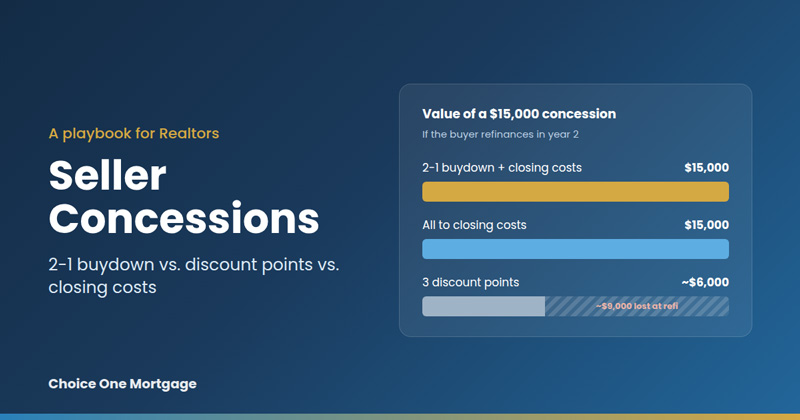
| 2-1 buydown | $10,548 | $4,452 | $0 |
| All to closing costs | $0 | $15,000 | $0 |
| Hybrid (1 point + 1-0) | $5,344 | $6,969 | About $2,687 |
| Permanent (2 points) | $3,608 | $6,000 | About $5,392 |
| Permanent (3 points) | $4,498 | $1,500 | About $9,002 |
If the buyer refinances, the temporary buydown and closing-cost strategies deliver the full $15,000 in value. Three points deliver less than half.
Seller Concession vs. Price Reduction
Many sellers offer a price cut instead. Here's how a $15,000 price cut compares to a $15,000 concession used for a 2-1 buydown plus closing costs:
| $15,000 Price Cut | $15,000 Concession | |
|---|---|---|
| Loan amount | $436,500 | $450,000 |
| Year 1 monthly P&I | $2,940.78 | $2,450.19 |
| Year 2 monthly P&I | $2,940.78 | $2,734.25 |
| Down payment (10%) | $48,500 | $50,000 |
| Closing costs covered | $0 | $4,452 |
| Buyer benefit in the first 2 years | About $3,700 | $15,000 |
To be fair to the price cut, its benefit is permanent. The buyer's loan balance stays $13,500 lower, including after a refinance. But in the years when cash flow matters most, the concession delivers about four times the value.
For the seller, net proceeds are nearly identical either way, and a full-price sale helps neighborhood comps. That's a useful talking point with listing agents.
The Choice One Mortgage Playbook for Realtors
- Call us before writing the offer. We'll run the buyer's numbers so the concession amount fits the loan type's cap and the buyer's actual goal.
- Use flexible contract language. For example: "Seller to credit $X toward Buyer's closing costs, prepaids, and/or interest rate buydown." That lets us allocate the money in the best way at closing instead of locking it into one use.
- Match the strategy to the buyer, with the refinance outlook in mind:
- Most buyers: a 2-1 buydown, with the rest going to closing costs. Ask for enough to cover a 3-2-1 if the loan type allows it.
- Short on cash to close: closing costs first. Make sure the buyer keeps reserves, since refinancing costs money too.
- Can't qualify at the par rate: permanent points, but only the minimum needed to get debt-to-income to work. Watch for the point where each extra point buys less.
- Plans to keep the loan 7+ years no matter what rates do: permanent points can make sense. That's the exception when rates are elevated.
- Don't overshoot. Concession dollars that exceed actual costs or program limits are lost. Ask for what the buyer can actually use.
- Watch the appraisal. The price, including the concession, has to appraise.
- Present refinancing as a possibility, not a promise. No one can guarantee rates will fall. The good news is that a temporary buydown still works if they don't, because the buyer already qualified at the full payment.
The Bottom Line
When rates are elevated and most buyers expect to refinance, the seller's money should buy certain savings now, not a bet on the next 30 years. For most buyers, that means a temporary buydown plus help with closing costs. Save permanent points for buyers who need them to qualify or who truly plan to stay put.
The Realtors who win are the ones who show clients these options with real numbers before the offer goes in, and that's what we're here for.
Have a buyer in contract or about to write an offer?
Call Bill Lewis at (310) 614-5920 for a free side-by-side seller concession analysis for your client.
Contact Us TodayFrequently Asked Questions About Seller Concessions
What is a seller concession?
A seller concession, also called a seller credit or seller-paid closing costs, is money the seller agrees to contribute toward the buyer's costs at closing. It can pay for closing costs, prepaid items like taxes and insurance, and interest rate buydowns. It cannot be used for the down payment or reserves, or paid to the buyer as cash.
How much can a seller contribute toward a buyer's costs?
It depends on the loan type and down payment. Conventional loans on a primary or second home allow 3% with less than 10% down, 6% with 10% to 25% down, and 9% with more than 25% down. Conventional investment properties allow 2%, FHA allows 6%, and VA allows 4% in concessions plus normal closing costs. Guidelines can change, so confirm current limits with your lender.
Is a temporary buydown or a permanent buydown better?
When rates are elevated and the buyer is likely to refinance, a temporary buydown usually delivers more value. Every dollar goes toward the buyer's payments, while discount points only pay off if the buyer keeps the loan past the break-even point, often five years or more. Permanent buydowns make more sense for buyers who need a lower rate to qualify or who plan to keep the loan long term.
Is a 2-1 buydown worth it?
It often is when rates are elevated and the buyer is likely to refinance. In our example, a 2-1 buydown cost $10,548 and saved the buyer $581 a month in year one and $297 a month in year two. Because unused funds are typically credited toward the loan payoff, the buyer gets the full value even after an early refinance. It helps less for a buyer who needs a lower payment to qualify, since buyers qualify at the full note rate.
What happens to temporary buydown funds if the buyer refinances or sells?
In most cases, unused buydown funds are credited toward the loan payoff, so the money isn't wasted. The exact treatment depends on the loan program and buydown agreement, so confirm the details with your lender.
Does a 2-1 buydown help a buyer qualify?
No. For conventional and FHA loans, buyers qualify at the full note rate, not the lower buydown rate. The upside is that if rates don't fall, the buyer has already been approved for the full payment.
How much does a discount point lower the interest rate?
It varies daily with market pricing. In our example, the first two points each lowered the rate 0.25%, but the third point lowered it only 0.125%. Points often buy less than buyers expect, and each additional point tends to buy less than the one before.
Is it better to ask for a seller concession or a price reduction?
For most buyers, a concession has a bigger impact in the first few years. In our example, a $15,000 concession used for a 2-1 buydown and closing costs delivered about $15,000 in value over two years, compared with about $3,700 from a $15,000 price reduction. A price reduction does keep the loan balance permanently lower.
What happens if the seller concession is more than the buyer's actual costs?
The buyer can't receive the excess as cash. Any amount over the allowable costs or program limit is lost or must be removed, often by reducing the price. That's why it's important to ask for an amount the buyer can actually use.
How should a Realtor write a seller concession into an offer?
Use flexible language, such as Seller to credit $X toward Buyer's closing costs, prepaids, and/or interest rate buydown. That lets the lender allocate the money in the best way at closing. Talk to your lender before writing the offer so the amount fits the loan type and the buyer's goals.
Will the buyer definitely be able to refinance later?
No one can guarantee that rates will fall or that a buyer will qualify to refinance. That's one reason a temporary buydown is a sound choice: it delivers savings right away and still works if rates stay where they are.
Does Choice One Mortgage work with Realtors in the Coachella Valley?
Yes. We work with Realtors and buyers throughout the Coachella Valley, including La Quinta, Palm Desert, Indio, Indian Wells, Palm Springs, Rancho Mirage, Cathedral City, and Bermuda Dunes, as well as across Southern California. Call (310) 614-5920 to run a seller concession analysis for your buyer.
Recent Articles
- Denied for a HELOC? Here's How You Can Still Qualify
- See all mortgage products
- Learn about non-QM loans
- Read our DSCR loan guide

About the Author: Bill Lewis
Mortgage Loan Originator, Choice One Mortgage · NMLS #284797
Bill Lewis has spent more than 30 years helping Southern California homebuyers and the Realtors who serve them structure financing that fits their real situation. Based in La Quinta, Choice One Mortgage serves buyers throughout the Coachella Valley, Ventura County, and the South Bay. Learn more about our team or call (310) 614-5920.
All rates, payments, and point costs in this article are for example purposes only and are not a quote or offer of credit. Actual rates and pricing change daily and depend on credit, loan type, property, and other factors. Refinancing is not guaranteed and depends on future market conditions and borrower qualification. This is not a commitment to lend. All loans are subject to credit approval, underwriting guidelines, and property valuation. Equal Housing Opportunity. COMC, Inc. dba Choice One Mortgage Company. Licensed by the CA DRE #01238593. NMLS #233784.